
Layered Wolf Cut Guide: 10 Styles for Volume & Movement
The hair cut is a wolf cut that has swept the hair world. You must have seen it in your social media or celebrities you like. It combines retro shag of 70s with edgy mullet of 80s. What ensues is a cool, messy and very stylish appearance. And the trick behind this hairstyle does not only lie in the shape. It is the layers. The layered wolf cut removes most of the problems that are encountered with hair. It gives life to flat hair and takes weight out of heavy hair.
It is applicable on virtually any hair texture. You do not have to be a styling expert in order to make it good. The disheveled appearance of the cut is what makes it appear more attractive when imperfect. When it comes to having a hairstyle that is volumetric, provides movement and a touch of attitude, this is what you are looking into. This guide takes ten different methods of rocking this trend and answers your greatest questions.
1. Classic Layered Wolf Cut

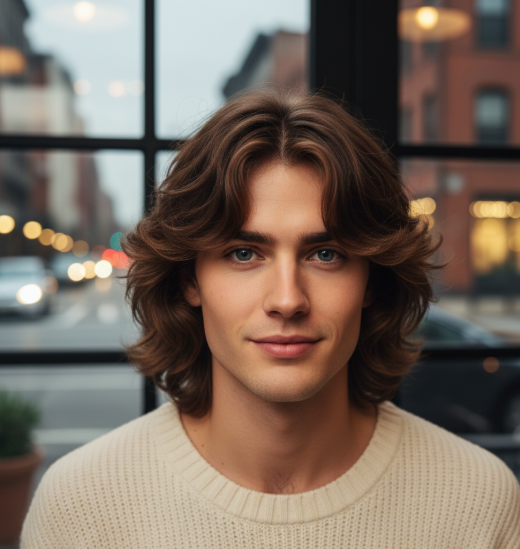
The whole trend is characterized by the traditional layered wolf cut. It uses disconnected layers extensively in producing its signature shape. Stylist cuts shorter pieces around the top of the head and top. These short works stand and form huge volume. Then the layers become longer, with their downwards movements towards the ends. This maintains the length and thins the bulk. It is the contrast between the short top and the long bottom that make up the wolf feel.
This particular cut fits individuals who have either wavy or straight hair, which is not too flat. The strata promote natural motions. In case you have pin-straight hair, you may have to seek assistance with products. Defining this cut is an area of concern when it comes to styling. You desire to bring out the distance between the layers. Apply a texturizing spray on dry hair. Coil the product in the roots and mid-lengths. This divides the strands and stresses on the dishevelly figure. It must appear untidy and casual hence do not over brush. The vintage appearance has everything to do with that disheveled, rocker-cool vibe.
2. Short Layered Wolf Cut

Shortening your profile with a wolf cut alters your whole profile. A short layered wolf cut tends to rest on the shoulders or even directly on the jaw. The layers here are necessary in the generation of lift. Since the hair is shorter, it is not pulled down by the gravity as much. The layers at the crown may actually spike up and form a rounded and voluminous shape on top. This kind of style attracts the eye upwards and centres the attention to your cheekbones and eyes.
This length has a wonderful appearance on the oval and round face sizes. It compensates roundness by incorporating height to the crown. It forms angles where none may exist. It is very simple to style a short wolf cut. You do not necessarily even require heat tools. Rub some matte wax or styling clay between your palms. Roll it over the wet or dry hair, dishevelling the back and flattening out the sides to some extent. This is aimed at building a piecey texture. It lasts five minutes in the morning and that is why it fits well in busy schedules. You would have the style with the least amount of effort.
3. Long Layered Wolf Cut

You need not sell your length to become a part of the wolf pack. The long layered wolf cut has your hair running along your back yet providing the needed shape. The long hair is usually heavy and pulls down the amount at the roots. This cut fixes that issue. You can add major layers, beginning around the chin or collarbone and this removes the pulling hair flat weight. The outcome is that which moves and bounces when one walks, long hair.
Here, it is important to balance the layers. You do not want to have a kind of mushroom effect with the top enormous and bottom narrow and skinny. An expert stylist mixture is made of the upper layers into the length slowly. This keeps it full on the bottom and lifts it up on the top. When it comes to styling long pieces of hair, it is essential not to allow the ends to be dead. Round brush should be used during blow-drying. Movement is made by turning the ends of the layers inwards or outwards. This mimics a blowout look. It makes the style appear purposeful as opposed to haphazard. It is the ideal combination of glitz and coolness.
4. Soft Layered Wolf Cut

Not all people would like to have a haircut that shouts punk rock. The gentle draped wolf cut is the elegant relative of the traditional style. This is the distinction between the cuts made by the stylist. The stylist does not chop with harsh and blunt strokes but employs a style of fading the layers into each other. The short to the long transition is smooth. You acquire the outline of a wolf cut with the lack of radical disconnection. It is light, airy and highly feminine.
The version is perfect in individuals who have fine hair textures. Dense layers may sometimes cause thinness of the fine hair. The soft blending helps the hair to be fuller. It would also be fantastic when you are afraid of trying the trend in the first time. There is a more natural style of styling. You do not have to use thick waxes and sprays. A mousse sprayed lightly on wet hair miraculously works. Allow your hair to air dry or diffuse on a low setting. The smooth layers will fall into a smooth wave. It is very romantic and breezy and can be worn on a daily basis.
5. Choppy Layered Wolf Cut
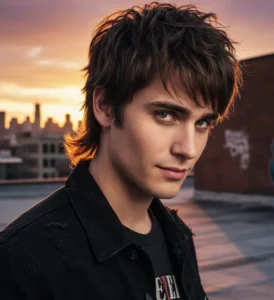
The choppy layered wolf cut gives you drama should you desire it. This style contradicts the soft version. It has flat, rough ends and layers of high contrast. The stylist makes deep cuts into the hair to make visible steps. This provides the hair with unbelievable texture and grit. It is worn-out, gritty, and highly contemporary. It imitates the style of rock stars of the 70s but with a new twist.
Nevertheless, this reduction does not apply to everybody. It needs heavy hair to sustain the rough structure. When you have thin hair the choppy layers will make it appear stringy or sparse. You must be also careful when your hair is very frizzy, because the small layers may swell up. The art of styling is about the eye of the prize. you must have a good pomade or a texture paste. pinch the ends of the layers with the stuff to make them look sharp. The ends also can be straightened using a flat iron to give a spiky finish. It is look of high impact which catches their eye.
6. Layered Wolf Cut with Bangs

Wolf cuts and bangs are a hair heavenly match. There are bangs that frame the face and they make the shaggy look complete. The most popular one is curtain bangs. They separate in the center and bend to the sides and integrate into the shorter upper layers. You may also choose full, blunt bangs in order to have a bolder touch or wispy bangs in order to have a soft touch. The bangs fill in the hole between the face and the rest of the wild layers.
The combination suits nearly all the shapes of the faces. It conceals a bigger forehead and brings out the eyes. The bangs are soft enough to flatten your jawline in case you have a square face. The bangs do need a little bit of attention done by style on a daily basis. Although you dry the rest of your hair by blowing on it, you normally need to blow-dry the bangs to make them lie down. With a small round brush create volume in them. Spray the bangs to the rest of the hair with a little spray. It renders the style sound and purposeful.
7. Layered Wolf Cut for Thin Hair

It is a myth that wolf cuts are only applied to thick hair only. The layered wolf cut gives the thin hair the illusion of fullness. It is the positioning of the layers. Strategic layering is a method of shedding weight on the top, and gaining weight on the bottom by the roots. The hair appears twice as thick when the roots are up straight. The shorter layers surrounding the crown help the hair not to lie flat on the scalp and this is one of the main complaints of the thin hair.
The depth of the levels is important. The amount of layering that your stylist needs to keep should be nearer to the top and the bottom length should not be thinning too much. You desire to retain density on the edges. The volume can be increased by use of styling tricks. Wet roots can be dried using a volumizing mousse. Light oils should be used to prevent the strands being heavy. In drying, turn your head topsy turvy. This causes the roots to dry at an elevated stage. After you roll over, you are immediately blessed with body. The layered wolf cut provides thick hair with the texture and oomph that it would otherwise be devoid of.
8. Layered Wolf Cut for Thick Hair
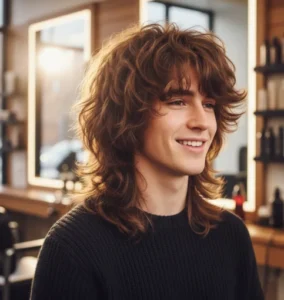
Thick hair is difficult to handle and the layered wolf cut is a wonderful way out. The ultimate aim in this case is debulking. When all of a length, thick hair is apt to become triangular and puffy. The massive weight loss in a wolf cut is done by the heavy layering. Thinning shears or a razor are likely to be used by the stylist to slice the density. This brings about a light and easy to handle feel to the hair. It gives the lightness to the natural texture without the weight.
The proper techniques should be used to manage heavy layers. You would like to escape the helmet appearance. The stylist is forced to cut movement in such a way that the hair has to lie flat where required. Thick hair layers are also important in controlling frizz. Layers that are dry may also protrude in case they are short. Apply a leave-in conditioner or anti-frizz cream that is hydrating. Extend it to the mid-lengths and ends. This brings the hair down only a bit so as to keep the poof in check but not the movement. It transforms a wild mane into a nice, arranged one.
9. Layered Wolf Cut with Face Framing

A good haircut is made an excellent one by face framing layers. These are a couple of strands that are trimmed to shape your facial characteristics. On a layered wolf cut, the bangs (assuming you have them) are tied by pieces of the face-framing to the longer lengths. They tend to begin at the cheekbones or jawline or in the chin. This attracts people to your finest assets. In case you adore your eyes, at least begin there. In case you wish to contour your jaw, it is hit by layers. The balance is vital. These front pieces make the wolf cut tamed down.
They also enable the style to be wearable and flattering in the front side. In the absence of them, the hair would feel like it is simply hanging around. It is easy to style face-framing layers. You can either bring them in to envelop the face or bend them outwards to achieve the retro feathered appearance. This is well done with a flat iron. All you have to do is to turn the iron a little when you are drawing the strand. It makes a gentle curve making your bones stand out. It also makes the cut seem personal to you.
10. Natural Finish Layered Wolf Cut

The natural finish layered wolf cut glorifies the natural texture of your hair. This style does not allow use of heat and heavy manipulation. It belongs to the individual who desires to shower, shake and walk. The cut is according to your natural hair wave or curl. The stylist cuts the layers either dry or with minimal tension to get to see how the hair falls naturally. This helps to ensure that the hair does not dry short in size and that it does not appear to be uneven when it dries automatically.
It is the final no-maintenance hairdo. You no longer fight your hair texture but begin working on it. The layers set free your natural waves which may have been oppressed previously. The way of the styling is the minimal. Wash and apply either a curl cream or sea salt spray. Use a microfiber towel to squeeze the hair, so as not to frizz. Then, let it be. Don’t touch it while it dries. The effect is natural, easy-going atmosphere. It saves time in the morning and makes your hair healthy as it does not damage it using heat.
Layered Wolf Cut FAQs
What is a layered wolf cut?
It is a fashionable hairstyle, a mixture of 7-80s shag and mullet, with layers of hair on top which are short and thick, and the layers at the bottom of the head are long and thin.
Does layered wolf cut add volume?
Yes, the layers which are short at the crown help to cut down on weight and the hair lifts at the roots creating great volume.
Layered wolf cut vs wolf cut difference?
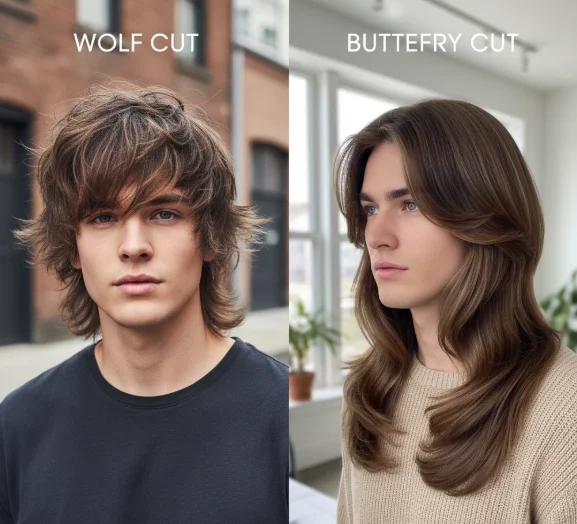
A typical wolf cut is always layered, whereas a layered wolf cut is characterized by the aspect of more emphasized texture and shorter, choppart pieces all through the length than its soft versions.
Is layered wolf cut good for thin hair?
Yes, it provides volume and root lift and thin hair is more full and voluminous than a one length cut.
Can layered wolf cut work on curly hair?
Absolutely. It is a great product that works perfectly well on curly hair by eliminating bulk and letting curls bounce and form themselves.
Is layered wolf cut high maintenance?
It is based on the texture of your hair. In the case of wavy hair it is low maintenance. Ease of use Straight hair may need daily styling using texturizing products or heat tools.
Which face shape suits layered wolf cut?
It is applicable to virtually all types of face, although it appears particularly attractive on round, oval and square faces because of the layers framing the face.
How often should layered wolf cut be trimmed?
To avoid keeping the shape and layers stale, it is advisable to have a trim after every 6 to 8 weeks.
Can men try layered wolf cut?
Yes, the wolf cut is a unisex appearance and is extremely popular with the men who desire a lengthier and textured appearance.
Is layered wolf cut trending in 2025?
Yea, it is still a leading trend as it develops with gentler twists and alternative ways of styling in the next year. Mullet wolf cut.